
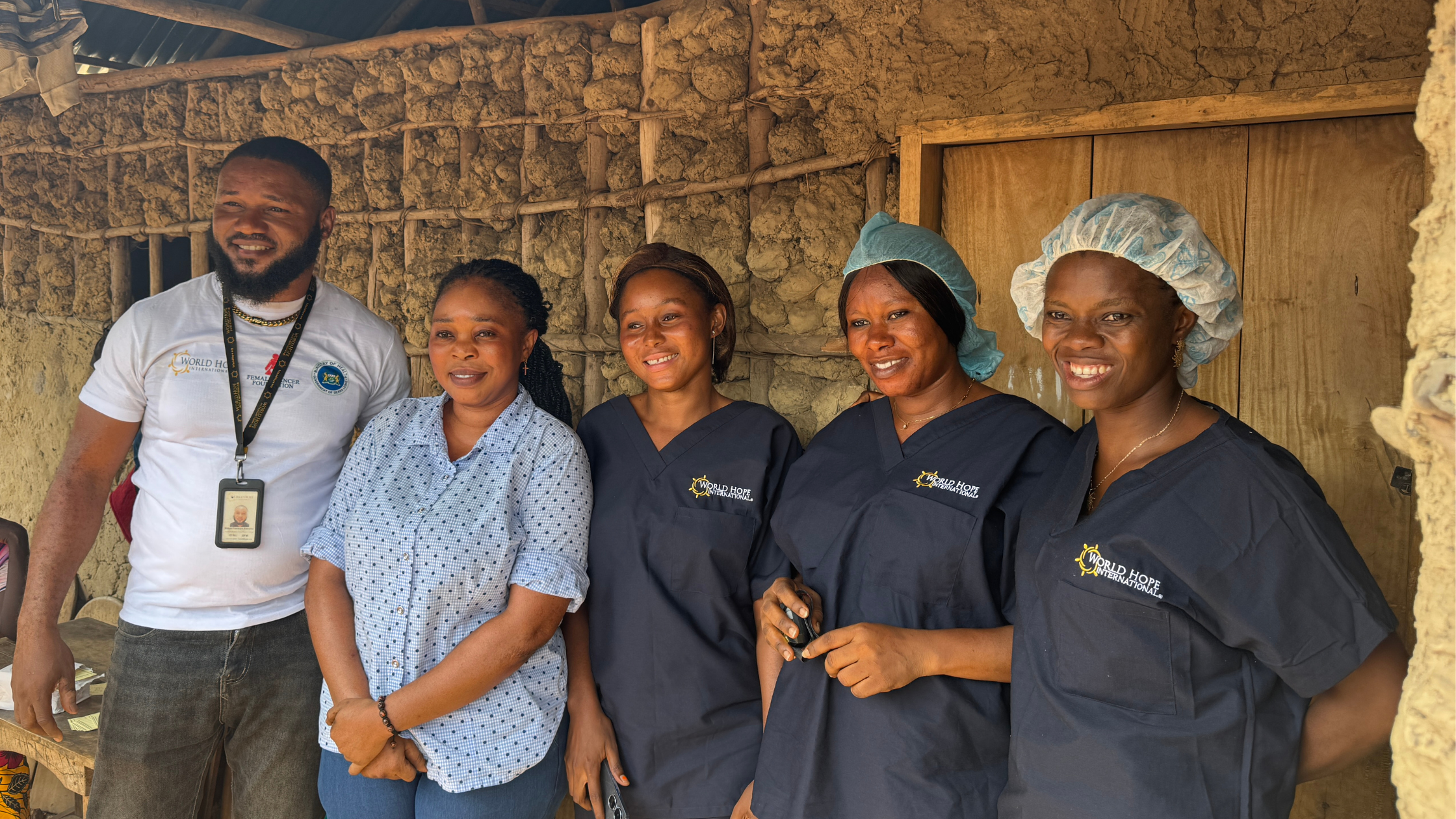
Miata is the cervical cancer screening program’s clinical lead in Sierra Leone. She first joined World Hope in 2021 as part of the Child Health and Mortality Prevention Surveillance (CHAMPS) team before transitioning into her current role.
Her interest in healthcare began early as she watched her father, a Community Health Officer, treat or refer neighbours and friends who were sick. As she got older, her mother was diagnosed with diabetes. Since her father was often away for work, her mother’s care often fell to Miata. It was through caring for her mother that she knew she wanted to be a nurse.
DYK? Community Health Workers are chosen by their local communities and trained by the Ministry of Health to serve as the first point of care and monitoring. They help to bridge the gap between remote villages and the formal healthcare system.
Miata once worked for an organization that focused on reproductive health. There, she was trained to perform cervical cancer screening and came to understand how important screening is. Later, when Miata saw an advertisement for World Hope International’s pilot phase for cervical cancer screening, she excitedly applied to be the program’s clinical lead.
She has been serving in this role for over 3 years, leading a team that includes a driver, two nurses, a community mobilizer, and a volunteer.
Since 2022, 30,585 women have been screened for cervical cancer, with 1,375 positive cases identified (4.5%), 1,348 treated (98% of positive cases), 120 referred for further care, and 339 known HIV-positive clients (1.1% of screened women).
Miata leads her team with quiet strength, recognizing that she sets the tone for her team. She is intentional about inviting them to share their ideas, recognizing that another team member may have an idea or answer to a problem she may be stuck on. She finds that as they talk as a team, ideas and solutions start to flow.
When asked what it would be like to follow her around for a day, Miata laughed and replied, “If you are spending the day with me, you are not sitting in one place!” On days when they are running outreach programs the team leaves very early, in order to connect with the women before they leave for their work as farmers, traders, or as office staff.
When they arrive in a community the team gathers all the women and men together to educate them about cervical cancer; what it is, what the symptoms are, and how screening works. Sexual and reproductive health in most remote areas is a taboo subject. The team’s approach is culturally sensitive and invites questions so that people can make informed decisions. While part of the team is meeting with community members, the rest work to set up a makeshift clinic.
If a woman chooses to be screened, the team does one on one counselling with her. They collect her personal and health information and tell her how the procedure will be done. After screening the team meets with her again to tell her the results, and what her next steps are. She is also given a card with the date of screening and when she will need to be screened again.
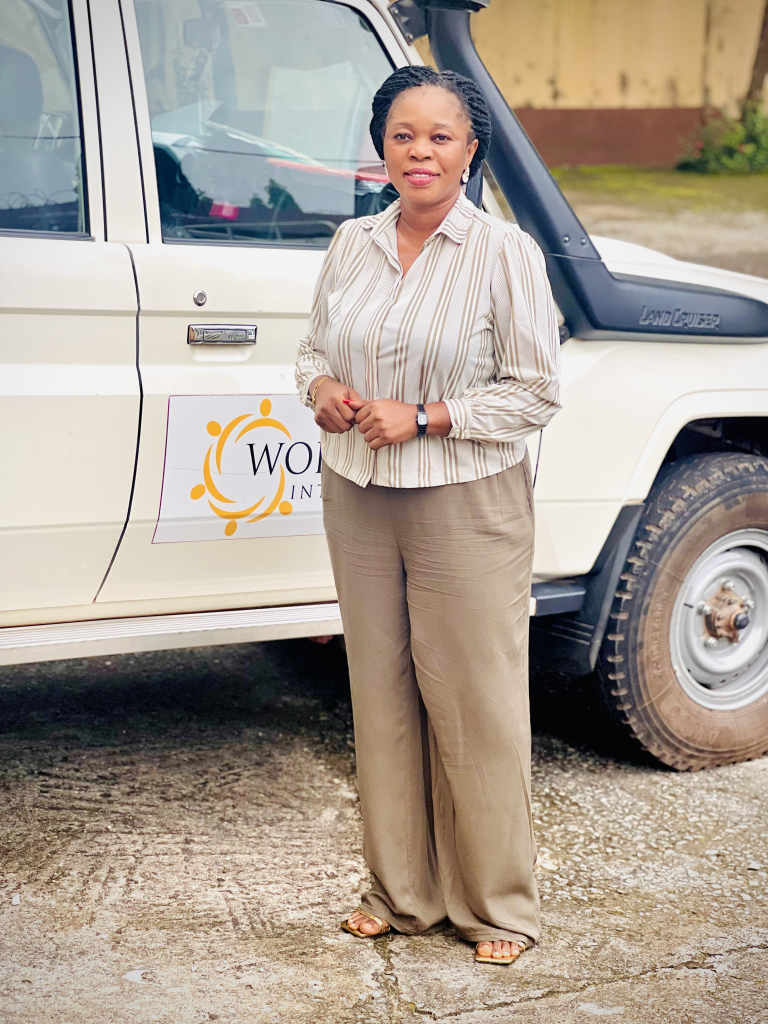
After all the woman, who chose to, have been screened, the team cleans up, sterilizes everything, packs the vehicle, and heads back into the city where they sync all the data that has been collected that day.
Miata’s work is motivated by the statistic, that globally a woman dies of cervical cancer every 2 minutes. And she knows that it is possible to change that number. She does this work so, “nobody is going to die from something that can be prevented.” Miata is encouraged by the words from Colossians 3:23 NIVUK that say, “Whatever you do, work at it with all your heart, as working for the Lord, not for human masters.” Though her work is for others, it is also in service to the Lord whose own life was given in service for others.
A cervical cancer screening clinic was held at a local university. After the information session, a student approached the team. She shared that her mother-in-law had been suffering for a long time with symptoms of cervical cancer. Her mother-in-law, in her late 40’s, did not live in the city but in a rural village 40 km away. The team inquired whether she had a phone and was able to get in touch with her. They helped her come to the city and screened her. She was positive for cervical cancer.
It was beyond the team’s mandate to treat, because more than 75% of her cervix was covered in lesions. The team referred her to a hospital in Freetown where she received surgery. Months later the team reconnected with this woman, Miata recalls, “I can never forget the happiness. She was so elated, and she said, if you hadn’t come here, my daughter-in-law would never have heard about this. I would have been a dead woman by now.”
Miata wants us all to remember the importance of women being screened for cervical cancer. It is preventable, and so inexpensive to prevent. However, it is expensive to treat.
Learn more about World Hope International’s Global Health Pillar.


World Hope International (Canada) is a registered charity.
Charitable #869500173 RR 0001
1830 Mountain Road, Suite C
Moncton NB E1G 1A9
+1-613-482-1499
Toll-Free: 877-482-1499
info@worldhope.ca

World Hope International (Canada) funds are confined to Board-approved projects. Funds designated towards a project are used as designated, with the understanding that when the need for that project has been met or cannot be completed for reasons determined by the Board, the remaining funds designated will be used where needed most.