
The biblical roots of holiness run deep in The Wesleyan Church. Sanctification, righteousness, and justice in the way of Jesus are still non-negotiable tenants of belief. The Wesleyan Church’s General Superintendent Emerita, Dr. Jo Anne Lyon states it succinctly. “God’s call to be holy moves beyond ourselves to act justly on behalf of others.”

This is reflected in the life of the founder of the Wesleyan movement, John Wesley. Wesley was an Anglican priest, who “quite unwillingly attended a society on Aldersgate Street and heard the reading of Martin Luther’s preface to the Epistle of Romans and felt his heart strangely warmed.”
The experience transformed Wesley through the power of the Holy Spirit. An ordained minister of the Anglican church; he found himself kicked out of the church, because of his radical teachings.
So, he went to the poor and oppressed, preaching in fields and alleyways. He saw firsthand and experienced with fresh eyes the exploitation of his flock and others by their employers.
He realized that systems and structures needed to change. That holiness was not just “me and Jesus” but, holiness is an outward facing life that impacts those around us. Holiness, justice, and righteousness are tied closely together.
Wesley and his followers began to support fair prices, a living wage, and honest, healthy employment for all. Through his ministry and teachings, the poor experienced empowerment to lead and take part in their own development in areas from learning, to reading, to being trained in business.
In 1791, before Wesley died, he wrote a letter to William Wilberforce, a member of the British Parliament and a man converted under Wesley’s ministry, to, “Go on in the name of God and in the power of his might, til even American slavery (the vilest that ever saw the sun) shall vanish away before it.”
It would take time, but in 1807, slavery was officially defeated in Britain by a landslide vote of 283-16. Wilberforce was the main catalyst behind this. In the US, however, it took even longer. Before the Civil War, during the Second Great Awakening led by Charles Finney, people heard the Gospel, were convicted of the evils of slavery, and became abolitionists.
They began to see the error of their ways and truly saw the plight of the poor. Ministries sprang up to meet their needs, and pastors preached the message of freedom for all, here on earth as it is in heaven.
This was not popular in all circles. As Wesleyan traditions and teachings took root in the US, division started to rear its ugly head. Orange Scott, one of the founders of The Wesleyan Methodists, scarcely knew slavery existed.
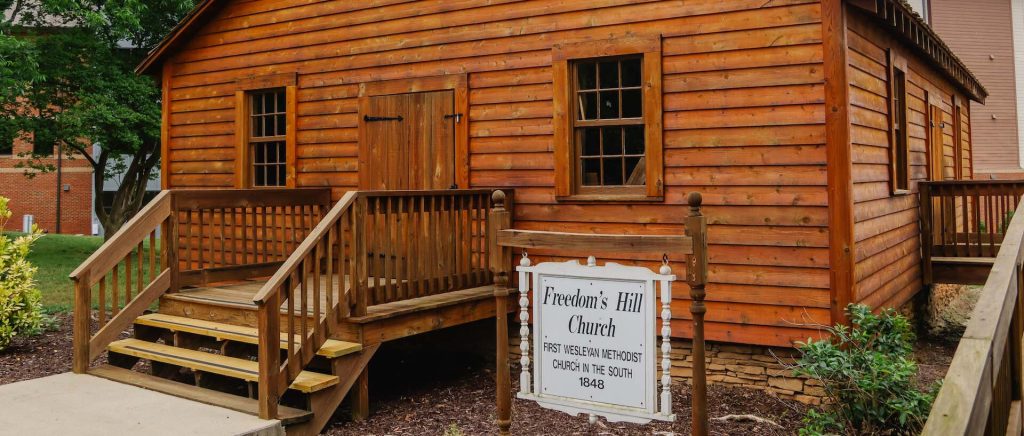
But in 1834, he wrote his first article opposing slavery. As the denomination continued to grow, one of the members in Ohio, Adam Crooks, moved to North Carolina to start Freedom’s Hill Church, a church where African Americans were welcome to worship freely.
A mob attacked the church and buried their bullets in its walls. Another mob dragged Crooks from his pulpit and beat him with his family and congregation watching.
One of his congregants, Micajah, was surrounded by a group of men and dragged away to be hanged. Walking towards the woods, they saw on old, leaning dogwood tree and someone commented, “An old dogwood tree is good enough to hang a Wesleyan on.”
He hung there until he lost consciousness. The mob then returned for the rope to hang someone else. They took him down and left him for dead, but he wasn’t dead. After regaining consciousness, he dragged himself across the ground until he was home, and his wife nursed him back to health.
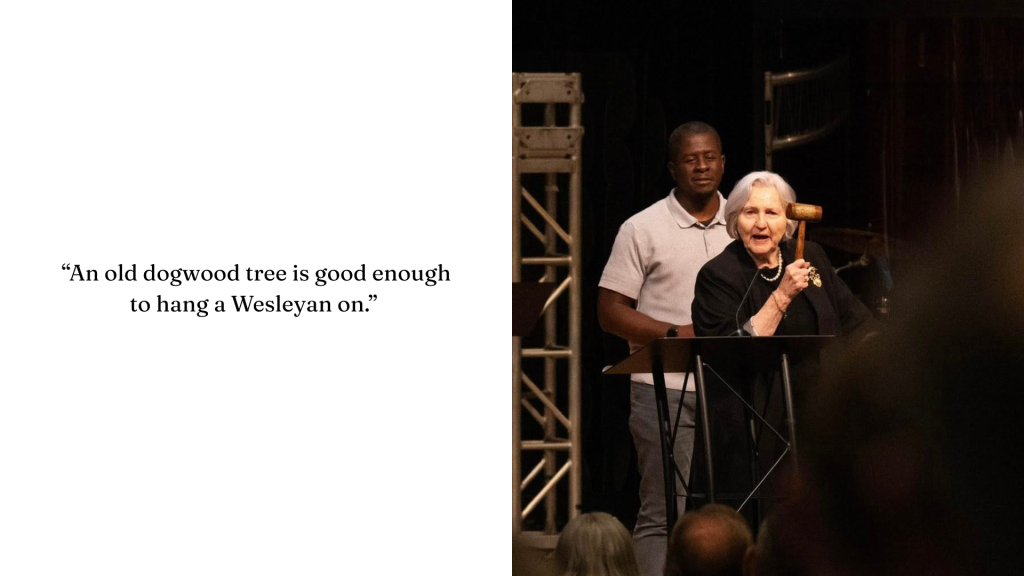
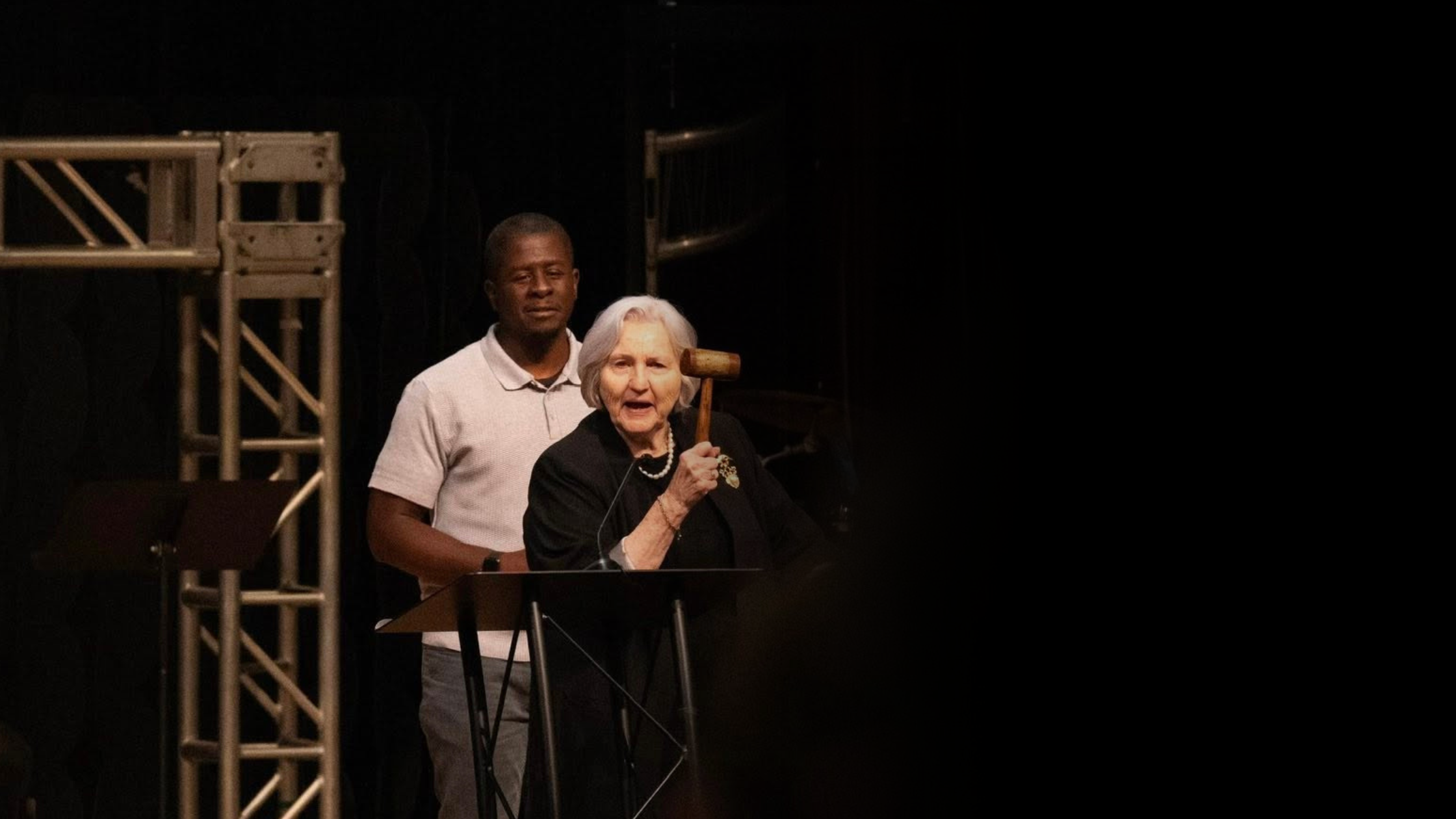
When Dr. Jo Anne Lyon was the General Superintendent of The Wesleyan Church, someone gave her a gavel fashioned from that same old dogwood tree, and it is now used at General Conference meetings as a symbol of our roots in justice and holiness.
From fighting for the rights of women, standing against slavery, teaching Sunday School and reading to children, to feeding thousands of poor and hungry souls, the roots of justice and righteousness run deep in The Wesleyan Church.
This is merely a brief overview of why World Hope International exists to bring hope in hard places. In the 1970s, social concerns began to trickle through the church. Dr. Jo Anne Lyon felt a calling to social justice, but there was no place for her to ground herself in that calling within The Wesleyan Church.
“Love the Lord your God with all your heart, mind, soul, and strength, and love your neighbour as yourself.” Jesus said. This is the call for all who call themselves Christian. Jo Anne states it this way, “Inward holiness and outward fruits go together.” You can’t have one and not the other and be living in the way of Jesus.
In 1996, Jo Anne started to dream about what it would look like for the Wesleyan church to impact some of the hardest places in the world in the name and way of Jesus. While travelling in hard places, Jo Anne witnessed unspeakable poverty and unprecedented depths of evil. She witnessed people falling and dying at her feet. Jo Anne saw where the lack of clean water, food, and medical care was so overwhelming that there seemed to be no way. She realized that money was not the only answer.
Jo Anne shares, “If the world could be fixed [so to speak] with money and political influence – the UN would have done that a long time ago – but the world is groaning for the redemptive power of Christ.”
As she began to share her vision to increase opportunity, restore dignity, and ignite hope in some of the hardest places in the world, people began to come alongside her.

As people caught the vision, they started giving generously and praying, birthing the official relief and development arm of The Wesleyan Church, World Hope International.
World Hope International Canada was birthed after Jo Anne was interviewed on 100 Huntley Street to raise money for Limbs of Hope. After visiting Sierra Leone, Jo Anne was overwhelmed by the many innocent people who lost limbs during the civil war. When she shared the need, donations began to flow in faster than anyone expected.
People want to be generous. They want to live out the Gospel but sometimes lack the knowledge and opportunity to do so. The transformational development work we do empowers people to be a part of the changes that are happening in their lives and communities. From defining their the needs, to being a part of the decision-making process, to being educated about the work; people who live in the areas we work in are part of the process.
This is one of the things that sets World Hope apart. John Wesley realized that the people had to be part of the process for lasting change, and this is still the way World Hope works. A beautiful thing about this is that it transforms everyone from the donor to the beneficiary. When we give generously to see God’s mission fulfilled, we are in turn transformed through our obedience.
“Jesus came to proclaim good news to the poor. He was sent to proclaim freedom for the prisoners and recovery of sight for the blind, to set the oppressed free, and to proclaim the year of the Lord’s favour.” This is Good News! Jesus is all about transforming lives. He has called His bride, the church, to partner with Him to do that. Transformational development work done in sustainable ways is impacting lives that will continue to do so for generations.


World Hope International (Canada) is a registered charity.
Charitable #869500173 RR 0001
1830 Mountain Road, Suite C
Moncton NB E1G 1A9
+1-613-482-1499
Toll-Free: 877-482-1499
info@worldhope.ca

World Hope International (Canada) funds are confined to Board-approved projects. Funds designated towards a project are used as designated, with the understanding that when the need for that project has been met or cannot be completed for reasons determined by the Board, the remaining funds designated will be used where needed most.